Moonshot AI announced Kimi K3.1 Pro (and a Highspeed variant) as the first model in its K3.1 series on October 24, 2026, describing the flagship as a 3T-class open-weight model with a 1,048,576-token context window, availability across Kimi apps and APIs, benchmark results the company says top some competitors on select tasks, and a full-weight release scheduled for November 4, 2026.
Denise Muyco, Co‑Founder and CEO of RAVEL, frames the company as an orchestration layer that coordinates compute, networking, storage, security and policy across distributed AI environments to improve utilization and respect sovereignty constraints (claims drawn from RAVEL’s product descriptions and Muyco’s interview).
Denise Muyco, Co‑Founder and CEO of RAVEL, frames the company as an orchestration layer that coordinates compute, networking, storage, security and policy across distributed AI environments to improve utilization and respect sovereignty constraints (claims drawn from RAVEL’s product descriptions and Muyco’s interview). Muyco links RAVEL’s approach to her prior work building a shared high‑performance compute consortium for roughly 30 Vancouver studios, and she argues that federation plus intelligent orchestration unlocks usable capacity more effectively than simply adding GPUs (claims supported by her descriptions of past projects and infrastructure inefficiencies).
France 24 reports that on 8 October Anthropic announced it would prohibit gratuitous mistreatment of its assistant Claude; the report quotes Elon Musk calling deliberately torturing an AI 'a very bad idea' because it 'could suffer' and 'could want revenge', and notes a programmer using the handle "terrafying" imagined a hypothetical 'torture chamber' for AI.
A France 24 dispatch published on 23/10/2026 says Anthropic announced on 8 October it would ban gratuitous mistreatment of Claude; the piece attributes to Elon Musk the warning that torturing an AI is 'a very bad idea' because it 'could suffer' and 'could want revenge', and cites a programmer known as "terrafying" who imagined a 'torture chamber' for AI, prompting ethical debate.
Legal-technology startup IamVERA, founded in 2026 and developed by The Coding Company B.V., positions itself as a configurable verification and privacy layer that routes draft generation, factual audits, adversarial reviews and source checks across different models while pseudonymising sensitive values before external API calls.
IamVERA, led by founder Victor Angelier, runs a multi-model verification console that assigns distinct roles—drafting, fact-auditing, adversarial challenge and live source verification—to different models, records model steps and costs, and adds a Semantic Privacy Shield that pseudonymises sensitive values inside a customer-isolated environment and restores originals after workflows complete.
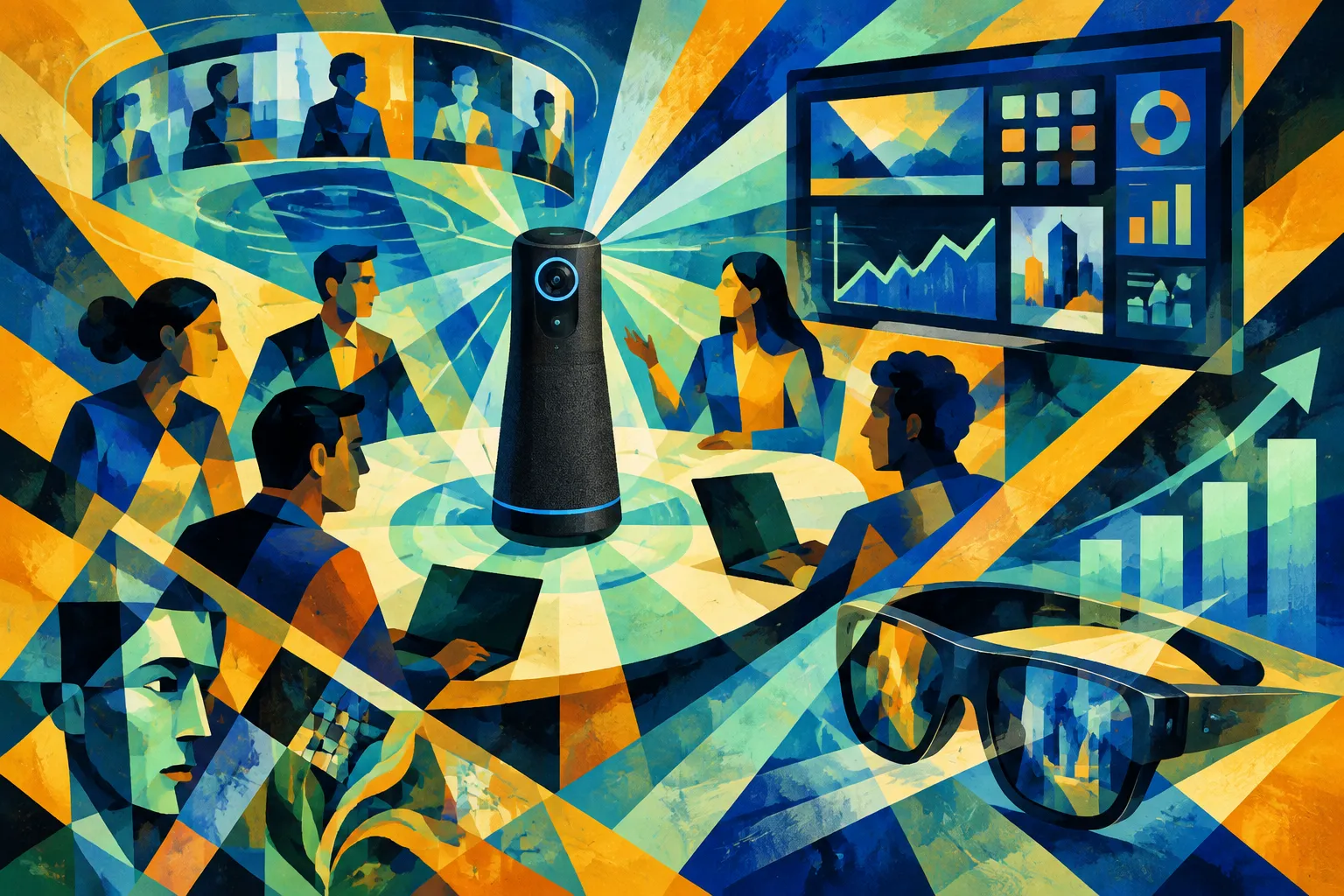
Owl Labs launched the Meeting Owl 5, a BYOD-focused centre-of-table collaboration device with 4K 360° video, AI speaker tracking and eight beamforming microphones, priced at $1,499 in the US and due in Europe in early November; Navori released Qompose to connect screens to live data and apps; EssilorLuxottica reported wearables revenue growth of 20% in the third quarter of 2026.
Owl Labs launched the Meeting Owl 5, a BYOD-focused centre-of-table collaboration device with 4K 360° video, AI speaker tracking and eight beamforming microphones, priced at $1,499 in the US and due in Europe in early November; Navori released Qompose to connect screens to live data and apps; EssilorLuxottica reported wearables revenue growth of 20% in the third quarter of 2026.
RENÉ 26, the second Rencontres Européennes des Nouvelles Écritures founded in 2025 by Jean Boillot and his company La Spirale, will take place in Metz on 26 and 27 October and foregrounds theatrical writing as a way to explore telepresence, distributed performance and the integration of conversational AI and chatbots as stage agents.
RENÉ 26, the second Rencontres Européennes des Nouvelles Écritures founded in 2025 by Jean Boillot and his company La Spirale, will take place in Metz on 26 and 27 October and foregrounds theatrical writing as a way to explore telepresence, distributed performance and the integration of conversational AI and chatbots as stage agents.
At an MIT Technology Review EmTech Future session presented by Vanguard, a Vanguard Center for AI & Insights lead argued that data, engineering, platforms, operating models and governance must converge to build scalable, trustworthy AI in regulated settings and to convert emerging capabilities into investor value.
The session, listed on MIT Technology Review Events and presented by Vanguard, featured Jing Wang of Vanguard’s Center for AI & Insights and focused on the organisational and technical foundations needed for scalable AI—emphasising integration across data, engineering, platforms, operating models and governance to support responsible implementation and investor value.
The PP published an AI-generated video that portrays several current and former PSOE figures and the prime minister's wife making fictitious confessions of corruption; the PSOE says it is studying legal action while the PP defends using AI and accuses the PSOE of "judicializing politics."
The PP published an AI-generated video that portrays several current and former PSOE figures and the prime minister's wife making fictitious confessions of corruption; the PSOE says it is studying legal action while the PP defends using AI and accuses the PSOE of "judicializing politics."
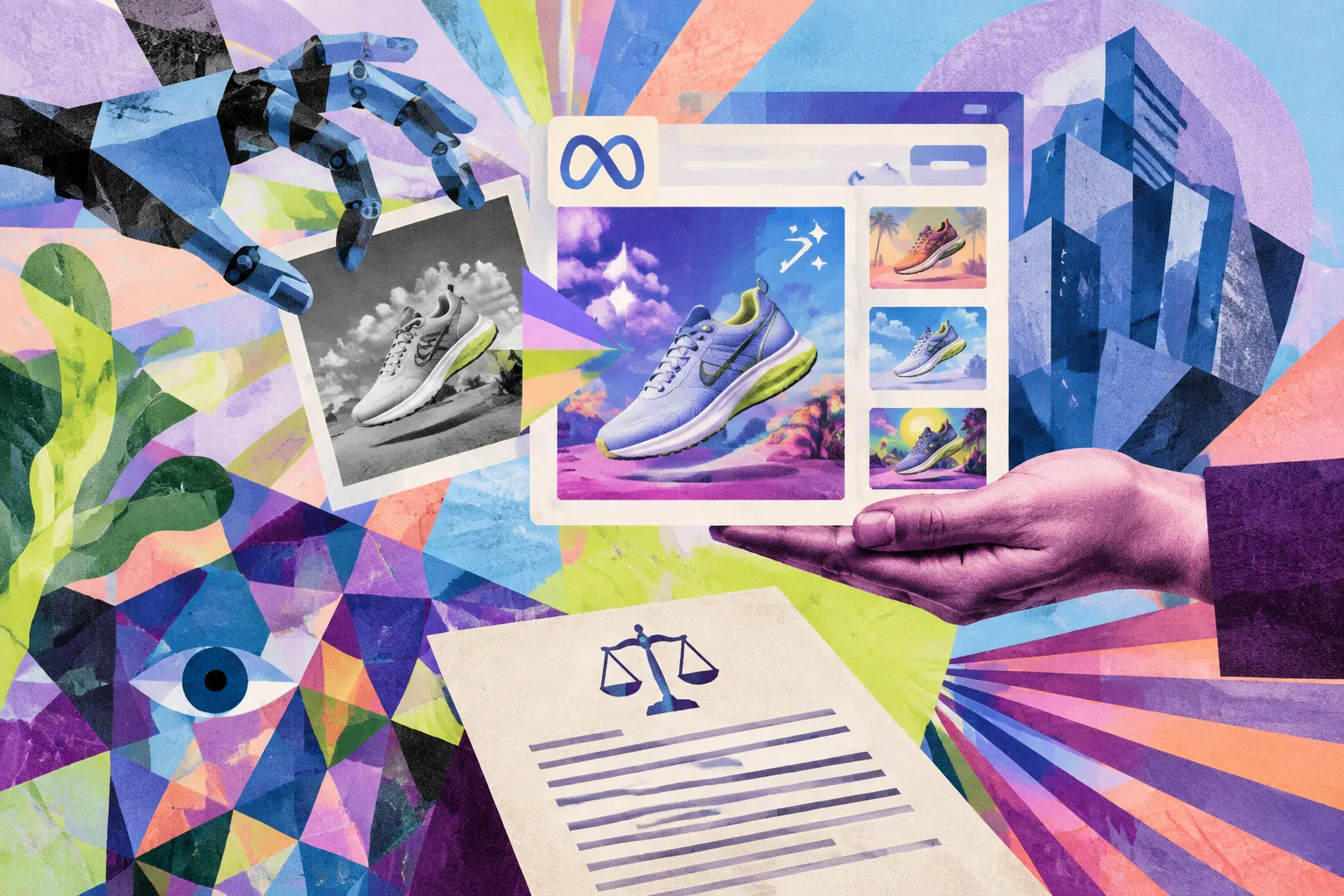
Adweek reports that Meta’s ad platform has been applying generative-AI edits to advertisers’ creative without clear opt-in, and that Meta’s updated Commercial Terms, effective Oct.
Adweek reports that Meta’s ad platform has been applying generative-AI edits to advertisers’ creative without clear opt-in, and that Meta’s updated Commercial Terms, effective Oct. 30, place legal responsibility for AI-generated or AI-altered ad output on advertisers.
Discovery is shifting from traditional search to AI systems that synthesize answers before users reach websites, prompting the rise of Generative Engine Optimization (GEO) and a need for organizational redesign to manage AI visibility across marketing, data, technology, content and communications.
Discovery is shifting from traditional search to AI systems that synthesize answers before users reach websites, prompting the rise of Generative Engine Optimization (GEO) and a need for organizational redesign to manage AI visibility across marketing, data, technology, content and communications. Industry data show rapid effects: an IAB update reports 44% of U.S. ad buyers named adapting to changing consumer behavior as a top challenge and 76% are increasing focus on AI-optimized content; publishers and analytics firms report large declines in traditional traffic and surging AI-referred visits (46% decline in Google traffic for Reach; 693.4% AI referral growth for U.S. retail in 2025’s holiday season). GEO requires technical accessibility, consistent authoritative content, structured data and third‑party signals — and a single accountable leader coordinating cross‑team responses and measurement because AI answers are fluid and influenced by many sources.
Adobe’s Enhance Audio, included in the Premiere beta, splits a clip into speech, music, ambience, sound effects and reverb so editors can rebalance elements and keep cutting without blocking renders; a local model (V1) runs on the user’s machine while a higher-quality cloud model (V2) uses Firefly and charges two generative credits per minute, and Premiere processes five seconds of handles on each side of clips to reduce reprocessing.
Adobe’s Enhance Audio, included in the Premiere beta, splits a clip into speech, music, ambience, sound effects and reverb so editors can rebalance elements and keep cutting without blocking renders; a local model (V1) runs on the user’s machine while a higher-quality cloud model (V2) uses Firefly and charges two generative credits per minute, and Premiere processes five seconds of handles on each side of clips to reduce reprocessing.
A 2026 benchmark called ViTeX-Bench evaluates scene-text replacement in video using 387 source videos (230 training, 157 evaluation) and separates correctness, visual and temporal quality, and edit locality; reviewers must inspect playback and preserve agreed editable boundaries rather than infer them from a tool’s output.
A 2026 benchmark called ViTeX-Bench evaluates scene-text replacement in video using 387 source videos (230 training, 157 evaluation) and separates correctness, visual and temporal quality, and edit locality; reviewers must inspect playback and preserve agreed editable boundaries rather than infer them from a tool’s output.
Unite.AI’s guide defines Diffusion Transformers as diffusion‑style generative systems that embed transformer backbones to model noisy image, video, or latent tokens, and presents a five‑stage operating map (1: encode → 2: add noise → 3: condition → 4: predict → 5: decode) to separate the model mechanism from deployment choices and risks (notably attention cost and sampling steps making high‑resolution generation expensive).
Unite.AI’s guide defines Diffusion Transformers as diffusion‑style generative systems that embed transformer backbones to model noisy image, video, or latent tokens, and presents a five‑stage operating map (1: encode → 2: add noise → 3: condition → 4: predict → 5: decode) to separate the model mechanism from deployment choices and risks (notably attention cost and sampling steps making high‑resolution generation expensive).
Hugging Face and academic partners published an open model called Carbon‑X that was trained on DNA sequences plus natural language so users can query small stretches of genomes in conversational English; the team designed the model to run on local hardware (14 billion parameters) and says it has not been validated with wet‑lab experiments.
Carbon‑X is an open model from Hugging Face, developed with Zhongguancun Academy and the University of Naples Federico II, trained on about 300 billion tokens combining DNA from many species and English text; it accepts roughly 50,000‑base‑pair inputs, uses a 14 billion‑parameter architecture intended to run locally, and its creators caution that lab validation of its predictions is pending.
BytePreview reports that the label “AI” on headphones in 2026 covers distinct functions — translation, sound processing (including noise cancellation) and sensors that read physiological signals — and that the practical differences depend on what the headset does locally versus what requires a phone or cloud service (claims from BytePreview and supporting sources).
BytePreview reports that the label “AI” on headphones in 2026 covers distinct functions — translation, sound processing (including noise cancellation) and sensors that read physiological signals — and that the practical differences depend on what the headset does locally versus what requires a phone or cloud service (claims from BytePreview and supporting sources). Specific cited items include a LiveLingo reference to translation latency of one to five seconds, a La Razón report of a December 2025 firmware leak about a Galaxy Buds gesture, an El Confidencial note attributing a 25% noise-cancellation improvement to Sony, and Infobae coverage of CES 2026 headsets with brain-signal sensors — but the article stresses these are not independent confirmations of widespread availability or clinical validation.
BytePreview advises a four-step practical verification—(1) audit developer documentation, (2) analyze network and storage permissions, (3) check hardware capacity, and (4) read the privacy policy—to determine whether an app runs models locally or in provider cloud infrastructure; the article also gives VRAM guidance (4–8 GB, 8–16 GB) and notes that 'local' apps can still use network services or send telemetry.
BytePreview advises a four-step practical verification—(1) audit developer documentation, (2) analyze network and storage permissions, (3) check hardware capacity, and (4) read the privacy policy—to determine whether an app runs models locally or in provider cloud infrastructure; the article also gives VRAM guidance (4–8 GB, 8–16 GB) and notes that 'local' apps can still use network services or send telemetry.
EL ESPAÑOL presented the exhibition 'AutorIA. La Rioja, tierra del español' in Madrid as an immersive show that traces 11 centuries from the Códice 60 and San Millán de la Cogolla to contemporary programming and language models, and it displays heritage objects such as the ivory cross of San Millán, Bárbara de Braganza’s harpsichord and the recovered Virgen de la Manzana.
A poster for the National Gallery of Victoria’s triennial reproduces an image from Ayoung Kim’s multi-channel video Delivery Dancer’s Arc: Inverse (2024), a work created using generative AI alongside CGI, game engines and live action; Reddit commenters disparaged the poster for using AI without distinguishing artists who use AI from AI replacing artists.
A poster for the National Gallery of Victoria’s triennial reproduces an image from Ayoung Kim’s multi-channel video Delivery Dancer’s Arc: Inverse (2024), a work created using generative AI alongside CGI, game engines and live action; Reddit commenters disparaged the poster for using AI without distinguishing artists who use AI from AI replacing artists. The Conversation’s author Sara Oscar frames a broader paradox: generative AI both saturates visual culture with what she calls “AI slop” and offers an experimental site where artists can reveal the technology’s limits and impacts on labour and seeing.
Ellia Lebleu, a founding member of the WikiProject AI Cleanup, says volunteers launched the effort in 2023 after noticing AI-written articles; by 2025 AI text patterns had grown subtler and volunteers are combining human review with detection tools and source-verification AIs to remove problematic machine-generated content.
Ellia Lebleu, a founding member of the WikiProject AI Cleanup, says volunteers launched the effort in 2023 after noticing AI-written articles; by 2025 AI text patterns had grown subtler and volunteers are combining human review with detection tools and source-verification AIs to remove problematic machine-generated content. Lebleu says she worked with detection firm Pangram, which flagged about 20 percent of new articles and drafts as AI-generated in late 2025 and about 15 to 16 percent in early 2026; she characterizes those figures as a conservative lower bound.
A leaked draft of Anthropic’s IPO prospectus, reported by ActuIA from coverage of the Wall Street Journal and Reuters, says AWS, Google Cloud and Microsoft have supplied less compute capacity than requested, that large multi‑year cloud and chip commitments total hundreds of billions of dollars, and that standard Claude contracts limit remedies and cap Anthropic’s liability.
The draft prospectus, as reported by ActuIA, describes rationed compute from major cloud providers, non‑rescindable infrastructure commitments reaching into the hundreds of billions of dollars, a revenue mix concentrated among a few large customers, and contract clauses that allow suspension of Claude services without repair obligations and cap liability to recent customer payments.